
I once timed myself at Gatwick: from the train platform to standing airside with a coffee took eleven minutes, because there was no bag to drop and no carousel to wait for on the far end. The passenger who shared my taxi from the airport in Porto had checked one suitcase. He was still at the belt when I’d found the bus.
That gap, forty minutes a flight, plus the checked-bag fee, plus the background dread of a lost case, is the whole argument for carry-on only. The trouble is that “pack light” is useless advice: it gives you the goal and none of the method. What follows is the method, refined over a few hundred flights and built around weight, fabric, and a kit you stop redesigning. The aim isn’t heroic minimalism, it’s a bag you can lift into the locker one-handed and a routine boring enough to repeat without thinking.
Start with the constraint, not the clothes
Most people pack by laying everything out and trying to subtract. That’s backwards. You end up negotiating with each item and losing every time, because each one is individually defensible, the umbrella might rain, the second pair of jeans might be needed. Every “might” wins on its own.
Instead, fix the container first and pack into it. I use a 40-litre bag and treat its volume as a hard wall, not a target, there’s a fuller case for that ceiling in why a 40-litre bag is the limit most travelers should respect, but the short version is that 40 litres fits nearly every airline sizer and stays honest. Now the question shifts from “what would be nice?” to “what earns its litres?”, and that one you can answer.
If an item only does one job, it has to be a job you’ll do most days. A rain shell qualifies. A dedicated pair of “nice shoes” for the one dinner you haven’t booked yet does not.
Do the weight math before you buy a thing
Carry-on isn’t only a volume limit; on budget carriers it’s a weight limit too, and weight is where the system quietly fails. A typical cabin allowance sits around 7 to 10 kg depending on the airline, which sounds generous until you weigh the empty bag. A hardshell case can be 3 kg before you’ve packed a sock; a good soft backpack is closer to 1.3. On a 7 kg limit, that two-kilo gap is roughly a third of your allowance spent on the bag itself. I keep a luggage scale in the hallway and weigh the loaded bag the night before, not at the airport, where the only fix is panic.
The arithmetic is unforgiving, and that’s the point. A week of mild-weather clothes comes to maybe 3 to 4 kg; add a 1.3 kg bag, a laptop and charger near 1.5, and toiletries around 0.5, and you’re at roughly 6.5 before the “just in case” pile. There’s no room for that pile. There never was, the scale just makes it visible.
Build a fixed clothing kit and stop redesigning it
The biggest time sink in packing is deciding, every trip, what to bring. Delete the decision. I run the same core kit for any trip from three days to three weeks, because you wear the same proportion of your wardrobe whether you’re gone five days or fifteen. The difference is laundry, not luggage.
The kit runs on a tight colour palette so everything combines, and on synthetic or merino fabrics that dry overnight. Cotton is the enemy: heavy, slow to dry, useless in a sink. Roughly, it’s a few tops, two bottoms smart enough for a restaurant, a mid-layer, a shell, one pair of shoes you arrive wearing, and five days of underwear and socks. That’s it, the list doesn’t expand for longer trips. Skipping checked-bag fees and excess-weight charges is quiet budget, too; one traveler folded exactly those savings into building a frequent-flyer miles balance without ever flying, because every fee you don’t pay goes somewhere better.
Then make the kit earn its space twice over: choose gear that does two or three jobs each. A merino buff is a scarf, an eye mask, and a neck pillow if you bunch it. A sarong-sized travel towel is also a beach mat and a dorm curtain. A power bank with a built-in plug deletes the wall charger. None of it is clever on its own, the point is the cumulative subtraction.
Your heaviest items, boots, the jacket, the chunky jumper, should be on your body at boarding, not in the bag. Airlines weigh the bag, not you. It looks slightly ridiculous in July. It works.
Pack the bag in a fixed order
Once the kit is settled, packing should be mechanical. I load the same way every time so nothing’s forgotten and the weight sits low and central, against the back panel:
- Shoes and the heaviest items first, at the bottom against the back, low centre of gravity, less strain on your shoulders.
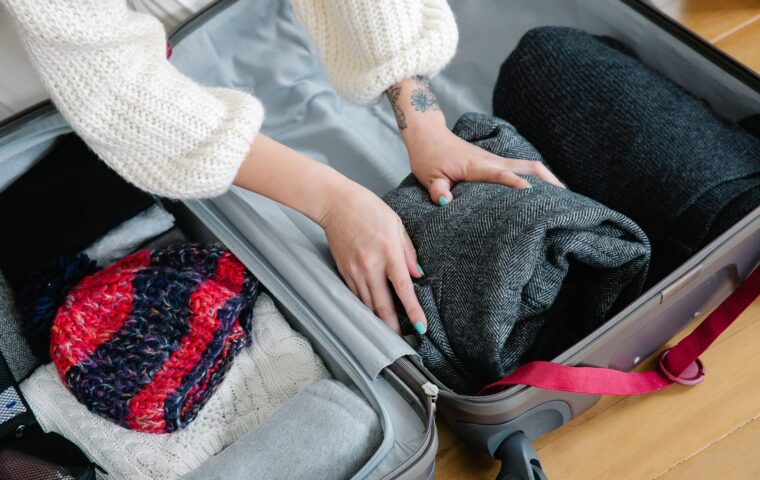
- Rolled clothing next, filling the main volume. Rolling beats folding for soft fabrics: it resists creases and packs tighter into corners.
- A flat layer of “smart” items on top, so they arrive presentable.
- Toiletries in a single clear bag in an outer pocket, under the 100 ml liquid rules, where security can pull it without you unpacking everything.
- Electronics and documents in the pocket nearest you, reachable without opening the main compartment in a queue.
The order matters less than the fact that it’s fixed. A repeatable sequence lets you pack in fifteen minutes the night before and trust nothing’s missing, the routine, not your memory, does the checking.
Solve length with laundry, not volume
Here’s the shift that makes the whole thing scale: a two-week trip does not need two weeks of clothes. It needs about five days of clothes and one load of washing. Sink-wash the merino, hang it overnight, and the wardrobe resets by morning.
I budget one proper laundry stop per ten days or so, a self-service place, an hour, a coffee, done, and handle the gaps with a sink and a travel clothesline. This is the lever that separates weekend carry-on packers from people who do it indefinitely: decouple trip length from luggage size and the bag stops growing with the calendar.
The classic failure isn’t underpacking, it’s the duty-free bottle or the “it was on sale” jumper that pushes a tuned bag over the limit on the flight home. Leave a little slack, or post heavy buys home. More of these traps are catalogued in 6 overpacking mistakes and the fixes that halve your load.
Won’t I look scruffy wearing the same few outfits for two weeks?
You’ll re-wear pieces, but so does everyone, they just pack more and use less. With a coordinated palette and overnight-drying fabric, you cycle a few good items and they stay fresh. Nobody you meet on day nine saw day two.
What about cold-weather trips, surely those need a checked bag?
Winter is the real test, and the fix is to wear the bulk and layer rather than pack thickness. One warm shell, a couple of thin insulating layers, and merino base layers cover a surprising range. The down jacket goes on your back at boarding, not in the bag.
Backpack or wheeled cabin case for carry-on only?
Mostly a weight question. A wheeled hardshell costs you 2 to 3 kg of allowance before packing; a soft backpack is lighter and handles stairs and cobbles, at the cost of carrying it on your shoulders. On a tight weight limit, the backpack usually wins.
Strip it back and the system is almost embarrassingly simple: fix the bag, do the weight math, run one repeatable kit, and let laundry handle the calendar. Build it once, and the reward repeats, you walk straight past the bag drop and start the holiday forty minutes early.