

The fare looked too good to ignore: a one-way hop across the continent for less than a decent dinner. Then I read the small print. “Personal item only.” No cabin bag, no overhead bin, just whatever I could wedge under the seat in front of me. I booked it anyway, then spent a week working out what that phrase actually permits.
It turns out “personal item only” is the most literal baggage category an airline sells, and the one travellers misread most often. People assume it means a small backpack, a slightly smaller roller bag, or whatever they brought last time. None of those assumptions are reliably correct, and the gap between the marketing and the gate agent’s tape measure is where the cost hides.
What “personal item” technically means
A personal item is the single bag an airline lets you bring into the cabin for free, on the condition that it fits entirely under the seat in front of you. The defining constraint is not weight, and it is not your intentions, it is the space beneath that seat. If the bag slides into that cavity without being forced, it qualifies. If it doesn’t, it doesn’t.
This is a different object from a carry-on. A carry-on goes in the overhead bin and is roughly the size of a small wheeled suitcase. A personal item is the thing you’d slide under your feet in addition to that suitcase. On a “personal item only” fare, the airline has removed the suitcase from the equation and left you the smaller allowance.
A personal item is whatever fits fully under the seat in front of you, typically a backpack, tote, or laptop bag, and nothing larger, regardless of how light it is.
The reason airlines define this so narrowly is operational, not punitive. Under-seat space is fixed and predictable; overhead bins are not, because passengers cram them, and the resulting boarding chaos costs time. The low price is your trade for staying out of the overhead.
The numbers nobody quotes you upfront
Here is where precision matters, because the published dimensions vary more than you’d expect. A typical allowance sits around 40 x 30 x 15 cm, but I’ve seen carriers go as small as 40 x 20 x 25 and others stretch to 45 x 36 x 20. That spread of a few centimetres sounds trivial. In packing terms, it’s the difference between a week’s clothes and a long weekend’s.
Weight limits, where they exist, tend to land around 7 to 10 kg, though plenty of carriers don’t weigh personal items at all, assuming a bag small enough to fit under a seat won’t be heavy. The dimensions are the binding constraint, not the scale.
The practical consequence: the allowance is per-airline, sometimes per-fare. Check the exact figures for your booking, on the airline’s own site, the day you pack. Don’t rely on what a different carrier allowed last year, or a forum post from 2019.
“Cabin approved” on a luggage label is a marketing claim, not a guarantee. Lay your bag down, measure all three dimensions including wheels and handles, and compare to your specific booking. A bag sold as “under-seat” can still be a centimetre too tall for one airline’s frame.
What actually fits (a realistic inventory)
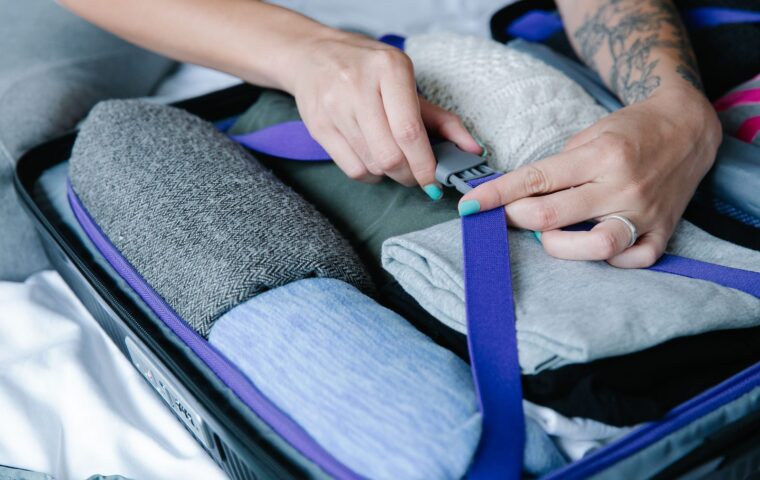
I ran the experiment properly: a 40 x 30 x 15 cm bag, packed for a five-day trip in mild weather. In went three or four t-shirts, two pairs of trousers, underwear and socks for the duration, a compact toiletry kit, a thin packable jacket, a charger, a paperback, and a laptop against the back panel. A functional trip, not a survival situation.
What did not fit: a second pair of shoes, a bulky jumper, a hairdryer, or the optimistic “just in case” pile that doubles most people’s luggage. Personal-item travel works because it forces ruthless editing, and the editing is the entire skill. Multi-use kit pays off here more than anywhere, a scarf that becomes a blanket, trousers that pass for both hiking and dinner.
The format rewards a particular kind of trip: short, warm, urban, laundry-accessible. It punishes cold-weather, formal, or gear-heavy travel, where the volume you need won’t compress into an under-seat cavity no matter how cleverly you roll.
The myth: “personal item only” means “pack lighter”
This is the misconception worth dismantling. People treat the personal-item fare as a lighter version of a normal trip, as if they’re just being asked to be a bit more disciplined. That framing leads to overpacking and a tense conversation at the gate.
“Personal item only” is not a nudge toward minimalism. It is a hard volume cap with a financial penalty attached. Exceed the frame and you don’t get a polite warning, you get charged a gate fee that frequently exceeds the original fare, sometimes by a multiple. The cheap ticket evaporates.
The mental model that works is the opposite of “pack lighter.” It’s “design the trip around the bag.” Decide the bag is fixed, then choose your wardrobe, destination, and laundry strategy to fit inside it. That inversion separates the people who travel happily on these fares from the people who swear off them after one expensive lesson.
Personal-item fees are deliberately steep and charged after you’ve committed to the flight, precisely when you have no leverage. A bag two centimetres over isn’t a rounding error to an agent with a sizer frame; it’s a revenue event. Sizing it correctly at home is the only defence that costs nothing.
When the upgrade is the smarter buy
Paying for a cabin bag isn’t a failure of discipline; sometimes it’s the rational choice. Travelling more than five or six days, in cool weather, or carrying bulky work gear? The upgrade fee buys volume you’ll genuinely use. The personal-item fare only saves money if you stay within it.
Run the arithmetic before you book, not at the gate. A “cheapest” personal-item fare plus an inevitable upgrade is often dearer than a standard fare that bundled a cabin bag. The same logic that makes a round-the-world ticket sometimes beat booking each leg separately applies in miniature: the headline price is rarely the price you pay.
The bag itself matters too. A structured under-seat bag protects its contents but loses internal volume to its own walls; a soft one fits more but wedges awkwardly. It’s the same trade-off you weigh between a hard shell and a soft bag for your main luggage, rigidity versus packability, compressed into a smaller, stricter frame.
How to fly this fare without a surprise
The whole game is avoiding the gate-fee ambush, and a handful of habits get you there. Weigh and measure your packed bag at home, including every protrusion. Screenshot your fare’s baggage rules so you can produce them if an agent disputes the allowance. And board reasonably early.
Know your own triggers, too. The behaviours that tip travellers over the limit at the gate are almost always the same few: packing the day of, adding a “small” extra bag, or assuming a bag that fit one airline fits the next. Catch those and the fare does what it promised.
Can I bring both a personal item and a laptop bag?
No, on a personal-item-only fare, that is your one item. The laptop has to go inside the single bag that fits under the seat, not as a separate piece. Two bags means a fee.
Will they actually weigh my personal item?
Often not, since dimensions are the real constraint and a bag that small is rarely heavy. But some carriers do enforce a 7–10 kg cap, so check your booking rather than assuming.
Is a personal-item fare ever worth more than a standard one?
Only if you stay within the allowance. Add the likely cabin-bag upgrade to the base fare and compare totals, a cheap personal-item fare plus a forced upgrade frequently costs more than a standard ticket that bundled a bag.
Treat “personal item only” as a measurement, not a mood, and it stops being intimidating. The fare hands you a fixed box and a low price, and leaves the rest to your planning. Measure the box, design the trip to fit, and the savings are real. Misjudge it by a couple of centimetres, and you’ll fund the airline’s next quarter at the gate.